Tiden
dancer(1) / film
Concept: Achim Bornhoeft
Choreography: Achim Bornhoeft, Jakob Jautz
Dance: Jakob Jautz
Music: Achim Bornhoeft
Tiden is the Low German word for “times”.
It is the third collaboration between dancer Jakob Jautz and composer Achim Bornhoeft.
Concept
The accumulation of objects reflects human hubris, the belief that one can defy one’s own transience through supposedly timeless “embodiments”. These physical representations manifest the desire both to remember one’s own life and to be remembered by others. These things are usually artefacts2 such as pictures, jewellery or other objects linked to specific people, places or events. Regardless of other external changes, they are always assigned a defined place and are thus transformed over time into relics whose significance extends beyond the material or practical value of the object. Underlying this is the endeavour to maintain their connection to present-day existence and to counteract the fact that, once torn from their immediate context of meaning, all things can never re-establish that context in the same form. The piece is thus an allegory of the impossibility of human endeavour to counter the omnipresent entropy and the associated loss of identity through the order and structure of material things. In “Tides”, the tides symbolise the realisation that, in the face of vast spans of time, everything tangible is merely a temporary form that sooner or later dissolves, vanishes, is lost or forgotten.
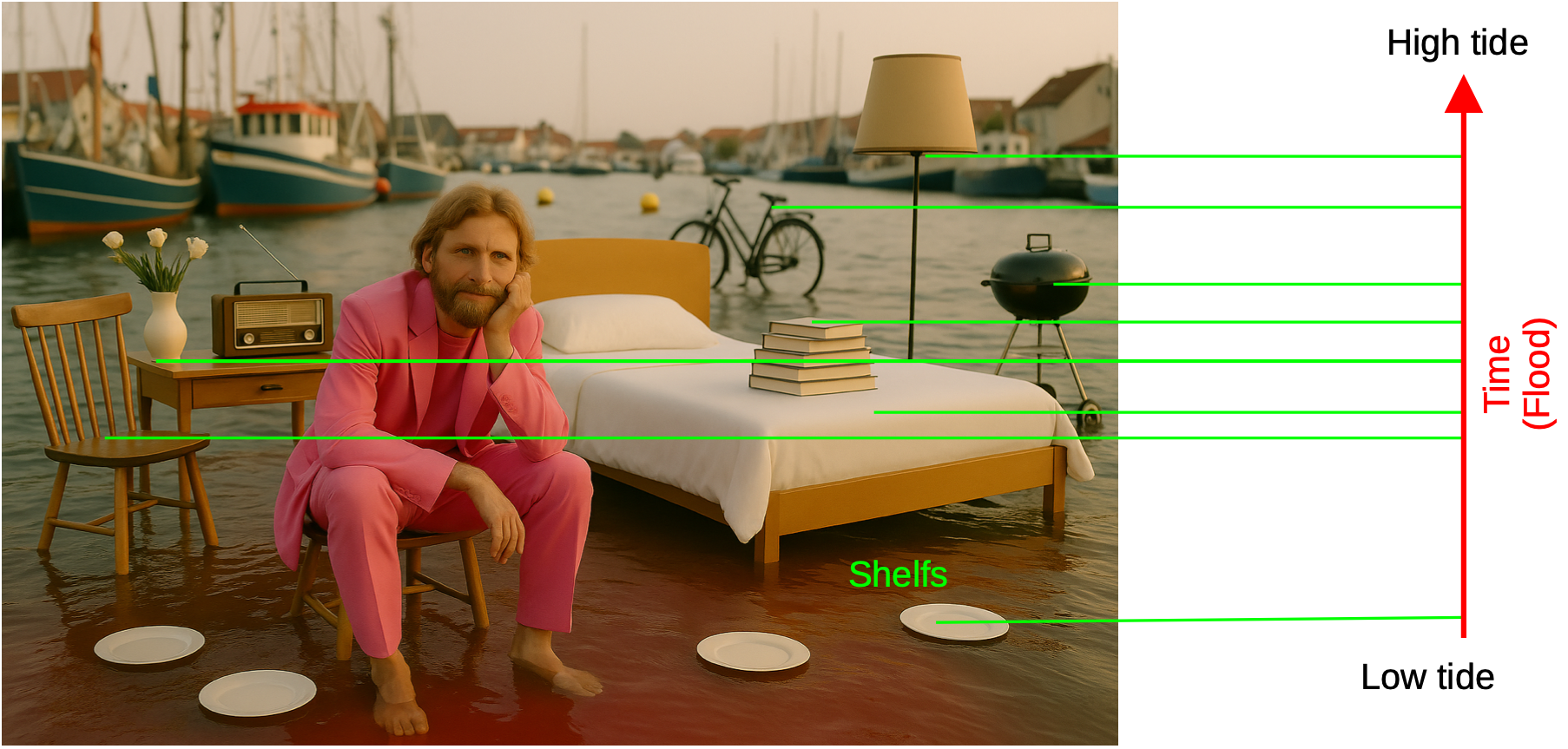
Description
A dancer sits fully clothed and surrounded by various objects at the bottom of a dry harbour basin on the North Sea at low tide, just before the tide begins to rise. The entire performance is recorded using at least two static and one mobile camera. 3 The height of all storage surfaces is designed such that, during the approximately 6-hour high tide, objects are washed over at regular intervals of about 10 minutes,4 objects float away (e.g. pictures, books, vases, etc.), materials become diluted or dissolve (e.g. colour pigments), things sink to the bottom and sounds “drown” (see illustration). The latter could be achieved using a metal wind chime and/or a battery-powered radio or record player. In addition, Bluetooth speakers are installed in some of the floating shelves, from which they drift off in random directions. The lighting is provided, amongst other things, by lamps that switch on or off upon contact with water.
The dancer’s movements are conceived as symmetrical loops and can therefore be performed forwards and backwards. The piece ends as the floodwaters rise, with the dancer swimming naked towards the sea. The film documentation is reversed after editing, so that the entire performance runs backwards. Due to the loops, the dancer’s movements appear almost natural even when played backwards. In the film, the impossible thus becomes possible: entropy ultimately gives way to order.
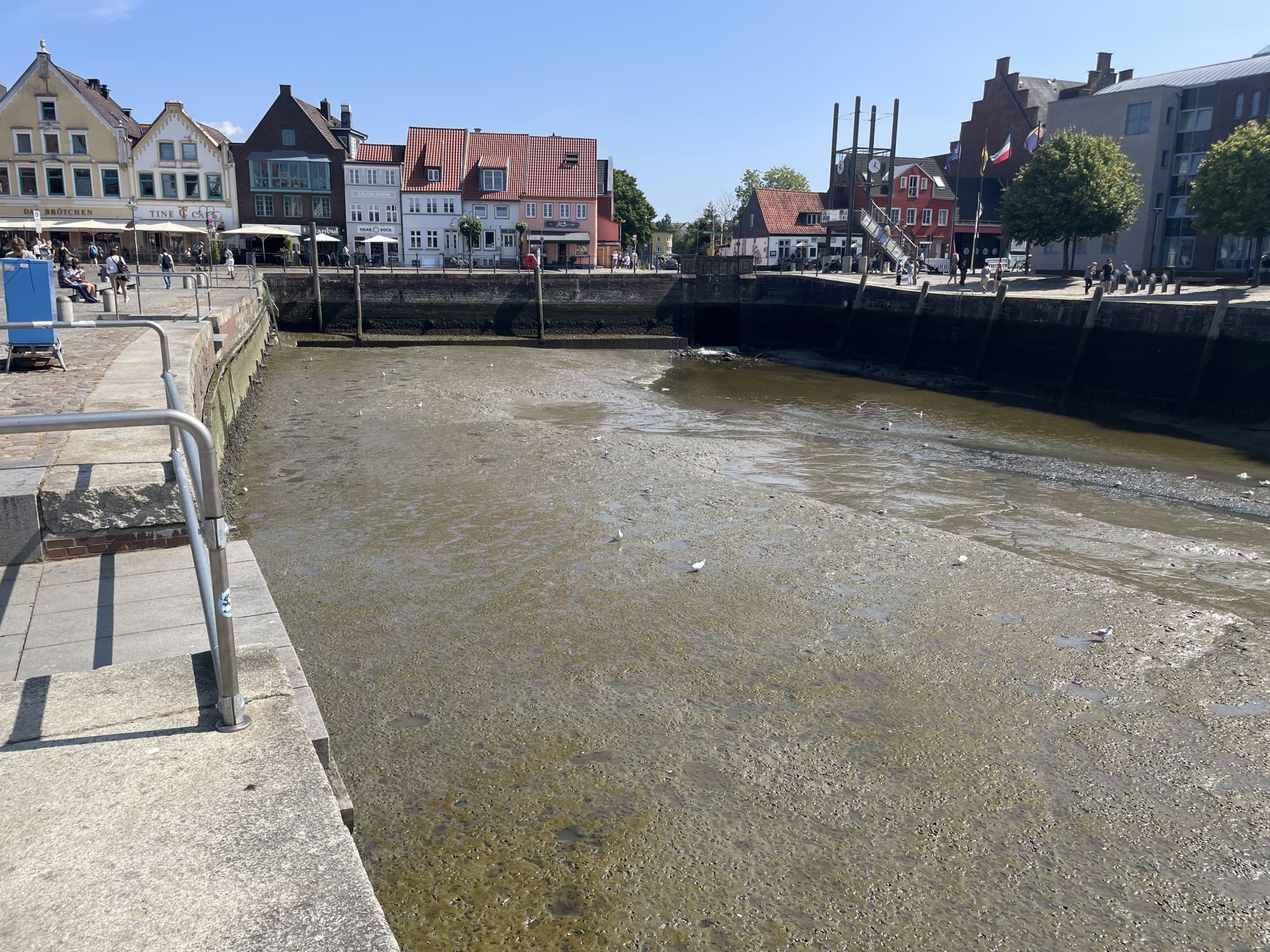
Inland Port, Husum, Germany
Venue for the performance, average tidal range over 3 m
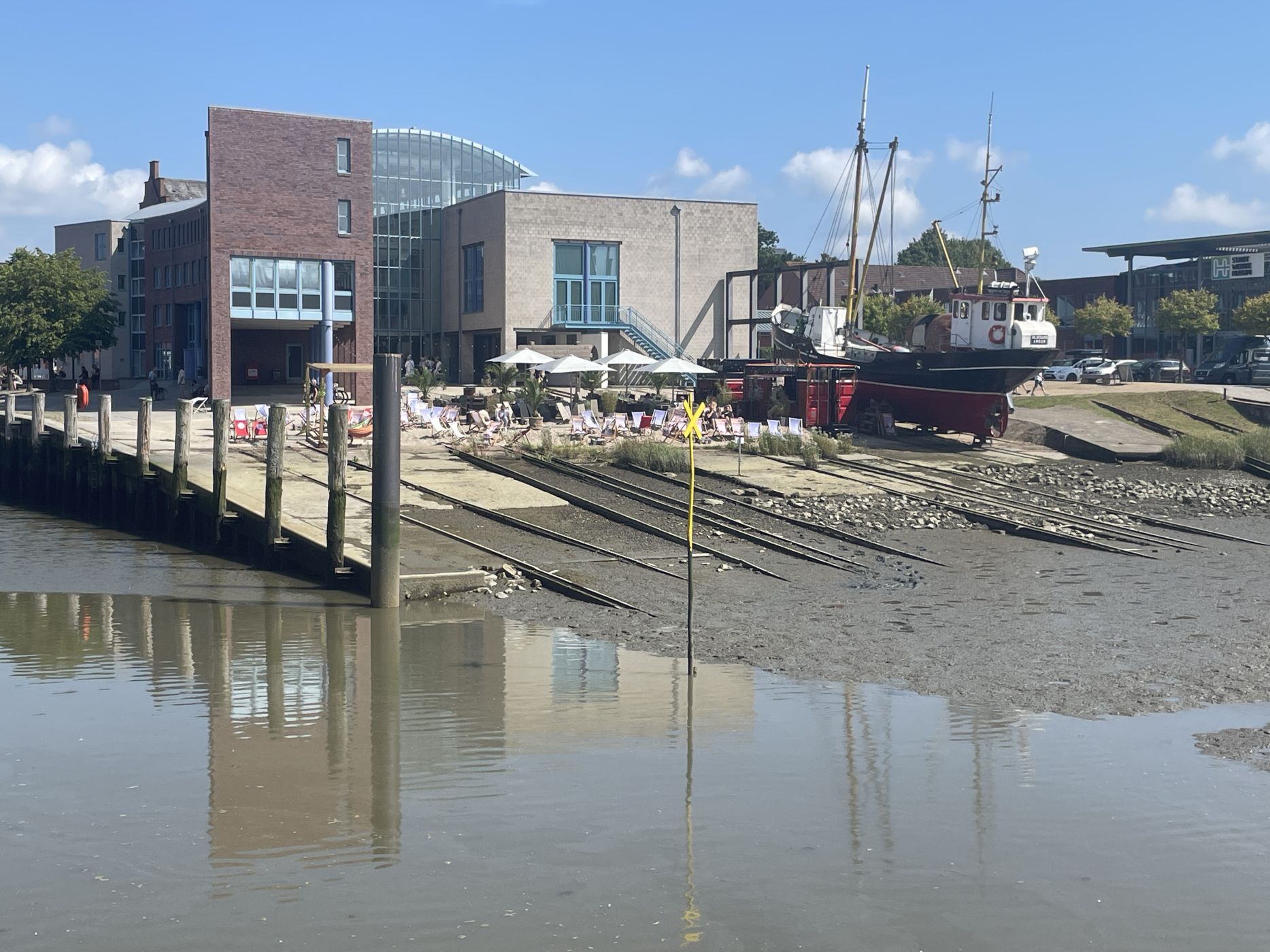
Old Slipway, Husum, Germany
(with lounge chairs from a nearby restaurant)
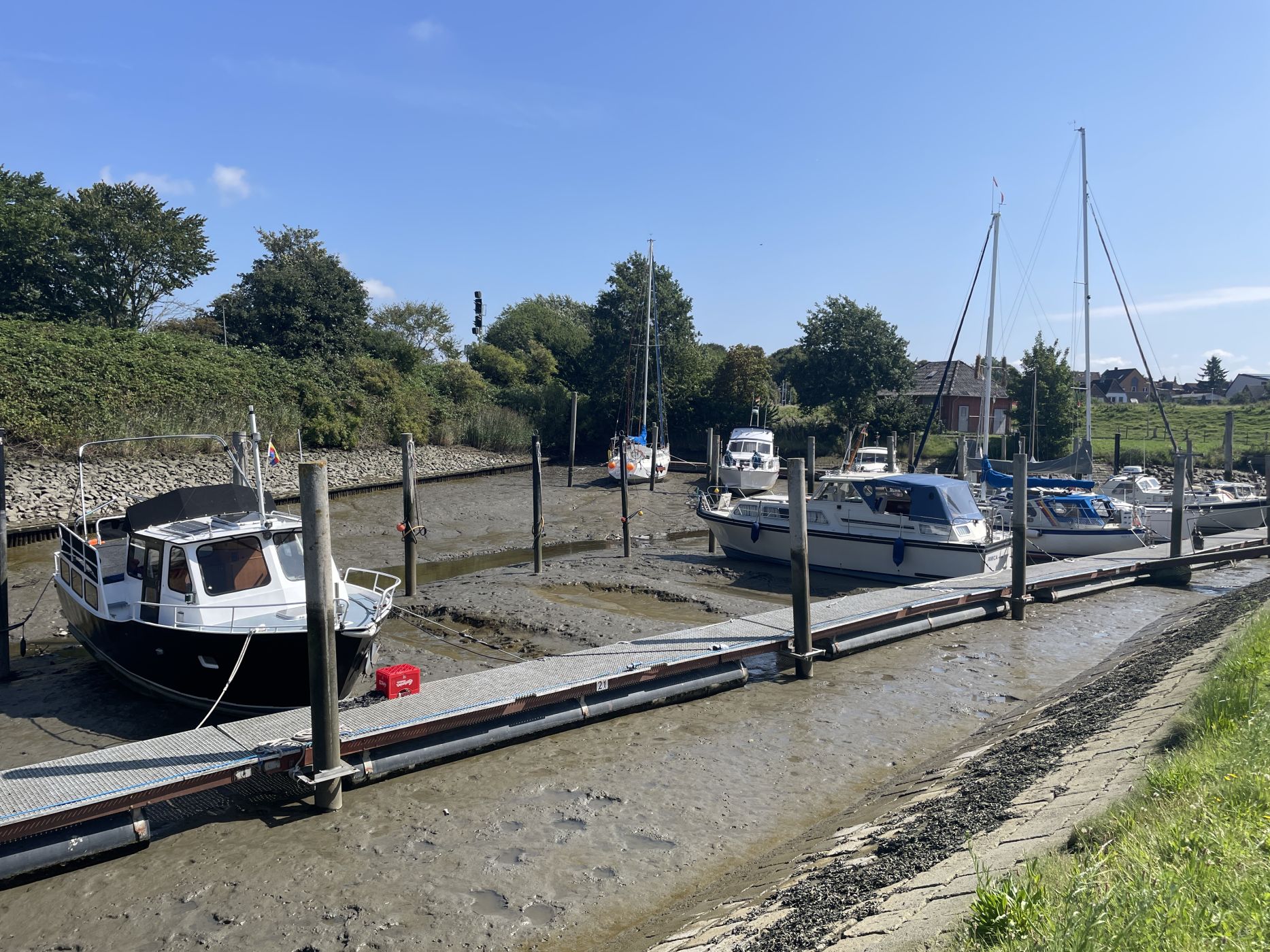
Husum Sailing Club Marina, Husum, Germany
Alternative Location
(Click on the images to open Google Maps/Streetview location.)